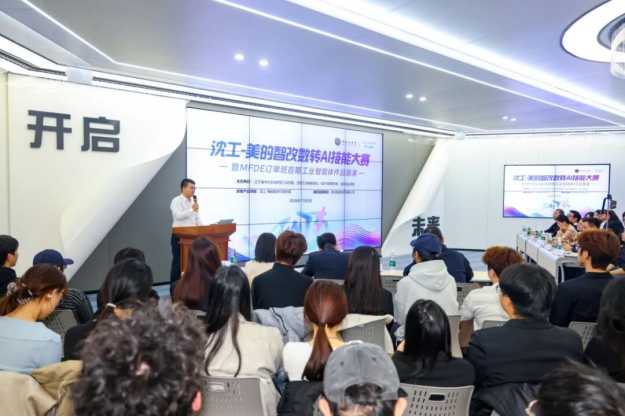
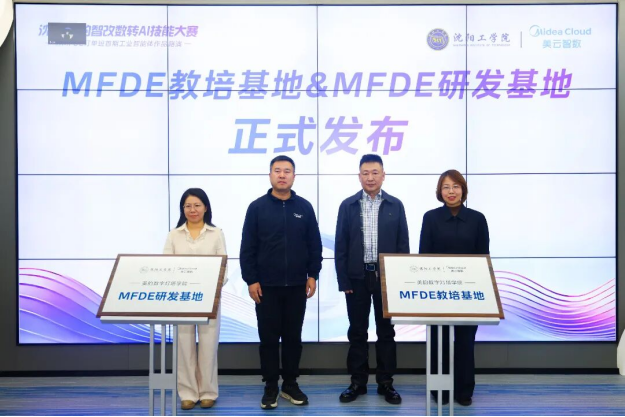
On November 5, the first MFDE education and training base in China — the Shenyang Institute of Technology (SIT)–Midea MFDE Education and Training Base and R&D Base — was officially unveiled at our university. On the same occasion, the SIT–Midea Intelligent and Digital Transformation Skills Competition and the roadshow of industrial agent works by the first MFDE order class were held. Seven intelligent and digital transformation teams and six groups of order-class students showcased enterprise diagnostic reports, industrial agent works, and industry-side evaluations, demonstrating the phased achievements of university–enterprise collaborative education. The competition connected project training, joint faculty development, and career development, further clarifying the practical path for MeiCloud and SIT to deepen industry–education integration. Wei Xiaogang, Vice President of MeiCloud, Midea Group; Wang Zhaobao, Chairman of the Board of our university; and Xu Ying, Dean of the Liaoning Institute of New Industrialization for SMEs and Vice President of our university, attended the competition.
Real Enterprise Projects Integrate the Talent Cultivation Process with Outcome Evaluation
In 2025, SIT and MeiCloud jointly established the Digital Lighthouse Academy, bringing digital scenarios covering the full chain of R&D, production, supply, sales, and management to campus. In May of the same year, the launch meeting of the “Intelligent and Digital Transformation Diagnosis” program of the Liaoning Institute of New Industrialization for SMEs was held at our university. Subsequently, the Institute and MeiCloud jointly visited enterprises to carry out diagnoses and formed “one policy per enterprise” transformation recommendations. On this basis, the topics of the student group in this intelligent and digital transformation competition were selected from real scenarios of the 339 “high-end textile and fashion brand” enterprises diagnosed by MeiCloud, and the related transformation recommendations provided the business basis for students’ practice. The student group consisted of 7 teams and 21 third-year students, who carried out practice around sorting out enterprise conditions, gap analysis, and solution design, and gave demonstrations combined with agent prototypes, showing their thinking process from identifying problems to designing tools.
The first MFDE order class showcased at the same event brought together 59 third-year students from 10 majors. After two months of training, they gave demonstrations in six groups of industrial agent works targeting pain points in enterprise operation and management. MFDE stands for Manufacturing Front-end Deployment Engineer, whose training goal is to combine business understanding, technical application, and project delivery capabilities, enabling students of different majors to learn to identify needs, develop tools, and deliver collaboratively in shared projects. MeiCloud introduced Midea’s full value chain business experience, the MeiQin platform, and project implementation methods into teaching, mapping 22 core business scenarios to 39 typical positions and converting position processes and output requirements into practical training tasks, combining agent development, diagnosis, and lean improvement in project training. Among them, two outstanding works focused on intelligent equipment operation and maintenance and on production scheduling respectively.
Enterprise Review Connects Outcome Recognition with Career Development
The competition invited experts from both the university and enterprises to serve as judges. In the review of the student group, experts from enterprises such as FAW and Midea participated in questioning, commenting, and scoring, bringing frontline business judgment on problem identification, solution adaptation, and application value into outcome evaluation. Enterprises observed students’ project experience and position potential, students obtained directions for improving their works, and the university–enterprise teams applied industry feedback to course and project guidance, keeping the cultivation process continuously responsive to industry needs.
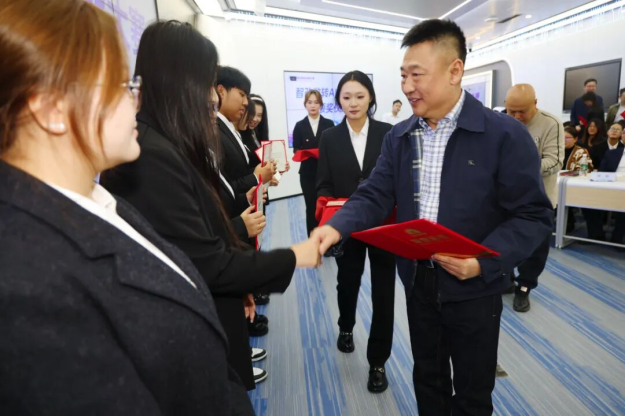
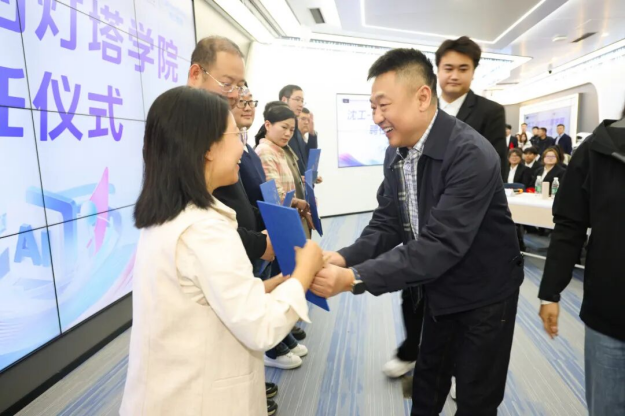
After the review, outstanding students of the order class and the winning teams took the stage to receive awards, and the winning teams of the intelligent and digital transformation competition were also presented with recommendation letters personally signed by the president, providing support for their future career development. In the previous SIT–Midea Digital Lighthouse Academy cooperation, 16 students had obtained junior digital talent certificates, and 30 students had entered internships in related positions at MeiCloud.
Distinguished Professors Pair Up for Mentoring, Deepening the Joint Faculty Development Mechanism
The university appointed seven mentors from MeiCloud as distinguished professors. Among them, six CST enterprise mentors from MeiCloud were paired with the 59 order-class students in groups for targeted, ongoing mentoring in project development, scenario refinement, and career development. The mentor team covers fields such as intelligent manufacturing, supply chain management, data operations, enterprise AI applications, and digital delivery, including experts with more than 15 years of practical experience in manufacturing and supply chains who have been deeply involved in Midea’s business transformation and digital engineering, as well as experts with over 20 years of experience in management consulting and AI, some of whom also have experience in university teaching, graduate supervision, and course development. Both sides integrate industry experience into the mentoring, guiding students to design solutions starting from business logic and to master development, implementation, and application verification methods in practice.
The Dual Bases Jointly Carry Talent Cultivation and Regional Industry Services
The launch of the dual bases is a further extension of the continuous deepening of university–enterprise cooperation between our university and MeiCloud. Relying on the Liaoning Institute of New Industrialization for SMEs and the Digital Lighthouse Academy, the two sides continuously meet the intelligent and digital transformation needs of regional SMEs through enterprise diagnosis, corporate training, and project practice. The common problems found in enterprise diagnosis and the demand feedback accumulated from training for specialized and innovative (SRDI) enterprises also provide the industrial basis for course development, practice topic selection, and talent cultivation, keeping university–enterprise cooperation closely connected with enterprise transformation.
Under this cooperation mechanism, enterprises can access the professional services and talent resources needed for digital transformation, while the university gains continuously updated industry topics and practice opportunities. As the dual bases come into operation, our university and MeiCloud will further promote the synergy of teaching, R&D, and enterprise services, linking five services — diagnosis, consulting, training, digital transformation, and talent cultivation — and exploring an operation model of regional empowerment centers in which talent cultivation and industry services reinforce each other, providing a practical reference for cooperation between more universities and industry partners.
The launch of the MFDE education/training and R&D dual bases relies on the university–enterprise collaboration platform, encouraging students to step out of campus, go deep into the frontline of enterprises, face real industry pain points in practice, and forge comprehensive capabilities in business understanding, technical application, and project delivery through project experience. With real industry needs driving talent cultivation, the two sides have built a complete education chain of “enterprises posing questions, students solving them, and the industry evaluating them.” In the future, the two sides will continue to leverage the dual-base platform, continuously transform industry resources into teaching nutrients, and cultivate more versatile Manufacturing Front-end Deployment talents.
Translated by Basic Courses Department