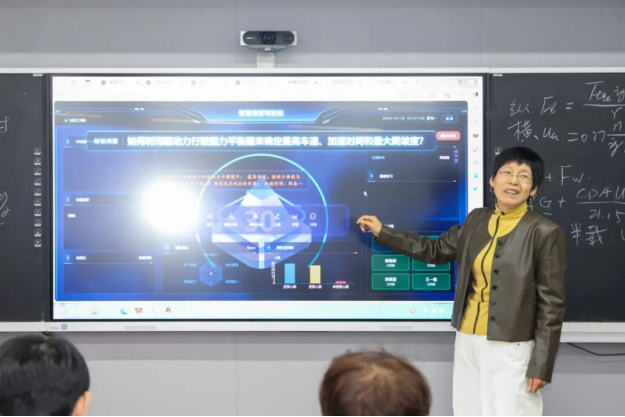
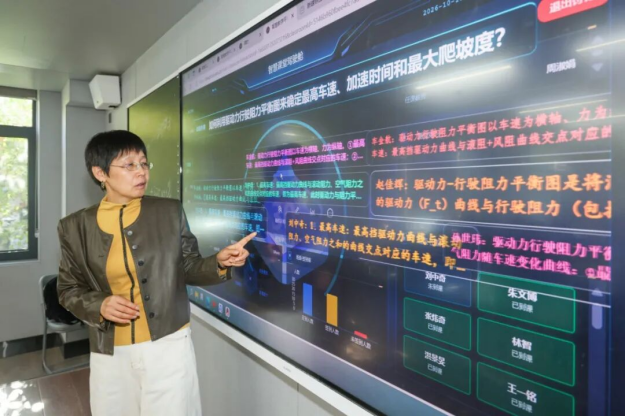
No more waiting for teachers to answer questions. Formula derivation and case analysis are available on demand. Students can preview and test themselves before class, run assisted simulation calculations during class, and explore industrial cases after class. The intelligent agent for the course Automobile Theory, developed by the Vehicle Engineering Program of the School of Mechanical Engineering and Automation, has been officially launched for classroom use. Built upon a three-in-one professional knowledge base, it covers the full teaching cycle spanning pre-class, in-class and post-class sessions. Acting as an on-call professional teaching assistant, it effectively addresses pain points in engineering studies, delivers personalized and diversified learning support for students, and improves the quality and efficiency of classroom instruction.
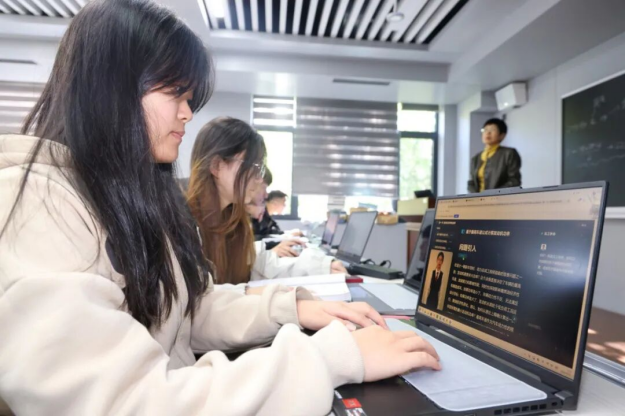
The intelligent agent has now been fully integrated into classroom activities, making learning scenarios more dynamic. Before class, students can use the agent to sort out key and difficult points such as fundamentals of dynamics and performance evaluation indicators, and independently build knowledge frameworks. They may raise preview questions at any time, and the AI automatically generates quizzes based on individual learning progress. Teachers and students can quickly identify knowledge gaps from the feedback.
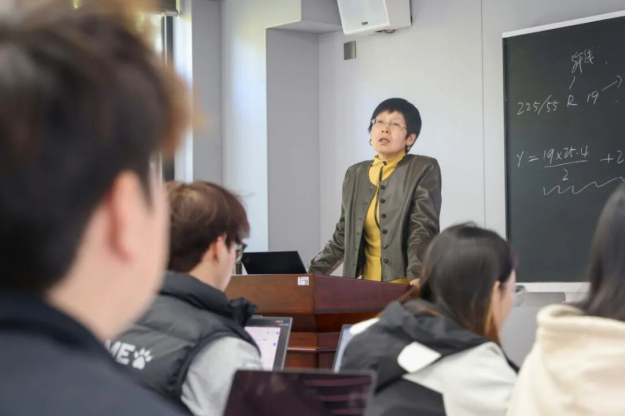
In offline classrooms, the intelligent agent serves as a powerful instructional aid. Students can instantly review and sort out formula derivations they failed to follow and doubts they had no time to ask instructors about in class. The agent supports course introduction, simulation computation and in-class exercises. This frees teachers from repetitive explanations of basic concepts, allowing them to devote more energy to unpacking complex knowledge points and discussing engineering cases, guiding students to think about practical issues in vehicle development and deepening classroom instruction.
After class, the agent removes constraints of time and location, enabling students to review at their own pace. For challenging computational problems, it breaks down calculations step by step to help students grasp difficult content. Meanwhile, it incorporates abundant real-world vehicle engineering cases, bridging textbook theories and automotive industry practice. Students with weaker foundations may review textbook content repeatedly, while advanced learners gain exposure to frontline industrial cases to broaden their horizons, truly catering to learners at different levels.
While supporting students, the intelligent agent also drives the continuous upgrading of teaching practices. While building the knowledge base and tuning and verifying the agent, instructors step out of conventional teaching mindsets and re-examine course difficulties from students’ perspectives. As the intelligent agent takes over a large volume of repetitive Q&A work, teachers gain more time to refine instructional design and communicate with students about their individual learning status, enabling genuine individualized instruction.
Automobile Theory is a core course for Vehicle Engineering majors. It covers professional theories including power performance, braking performance, handling and stability, alongside extensive mechanical formula derivations, performance calculations and vehicle operating condition analyses. Restricted by class hours, the traditional teaching model struggles to accommodate every student’s learning rhythm. Some students take longer to understand formulas and cannot get timely help when encountering difficulties in problem-solving and simulation debugging. Meanwhile, high-achieving students wish to explore industrial engineering cases but lack corresponding learning opportunities in class — a prominent practical challenge in professional teaching.
To tackle these challenges, the curriculum team built a three-in-one professional knowledge base consisting of classic textbooks, automotive industry standards and complete-vehicle engineering cases. The team repeatedly refined prompts, proofread and validated content, and optimized test questions and engineering case resources to ensure that formulas, solution procedures and engineering scenarios generated by the agent align with the course syllabus and suit the cognitive level of our students. Going forward, the university will continue to leverage the Shengong Smart Teaching Platform, summarize experience in developing intelligent agents for engineering courses, iteratively upgrade digital teaching resources, and promote deep integration of artificial intelligence and specialized instruction. Through digital and intelligent reforms, it will empower the cultivation of application-oriented talents and steadily enhance the quality of undergraduate classroom teaching.
Translated by Basic Courses Department