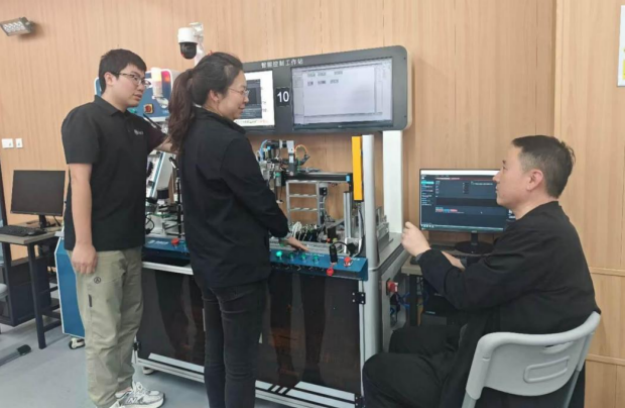
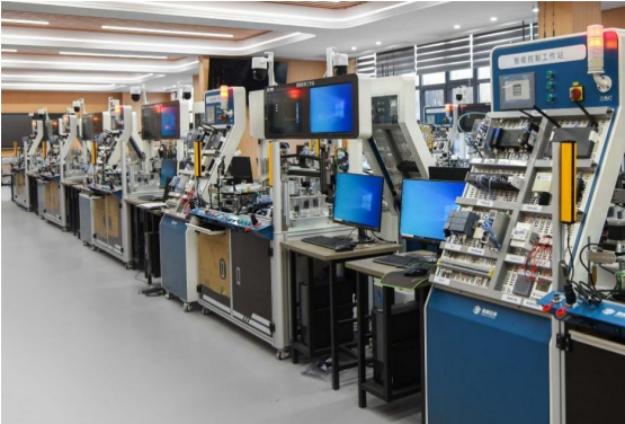
Recently, our university completed the construction of the KH62-00 Intelligent Control Practical Teaching System. The practical teaching team of the Shen Gong–Inspur Digital Micro Production Line Industry College independently developed an intelligent agent and deeply integrated it with a real intelligent production line workstation, enabling automated control of equipment and production lines. Supported by course resources, software platforms, and engineering tools, the system forms an integrated engineering practice platform featuring “real machines + digitalization + AI.”
The intelligent agent works in coordination with an S7-1200 master controller, dual-servo manipulators, a rotary-table stepper, a variable-frequency conveyor, and vision/RFID/IO-Link identification equipment. Through protocols such as S7, Modbus, TCP, and CAN, it performs real reads and writes on physical I/O, drives, and sensors, forming a closed loop of “perception–decision–control–feedback.” The system adopts a dual-PLC architecture of “master control + environmental acquisition,” supporting teaching of cross-PLC communication and distributed acquisition. The workstation is real production-line-level equipment, allowing students to complete configuration, programming, debugging, and verification under real working conditions.
On the basis of real machines, the team developed practical project topics covering seven series—motors, sensors, buses, networks, data, safety, and PLC programming—and 59 project topics. It produced bilingual teaching materials comprising 118 Chinese teacher and student editions and 100 English editions, together with 12 overall plans and 20-workstation teaching management plans. Projects such as dual-axis trajectory drawing, environmental bus acquisition, S7 cross-PLC communication, CAN voice broadcasting, firewall auditing, and real-source sampling have passed on-site testing. Among them, dual-axis trajectory drawing has a static deviation of approximately 0.3 mm, realizing a teaching loop from "explaining principles" to “real-machine verification.”
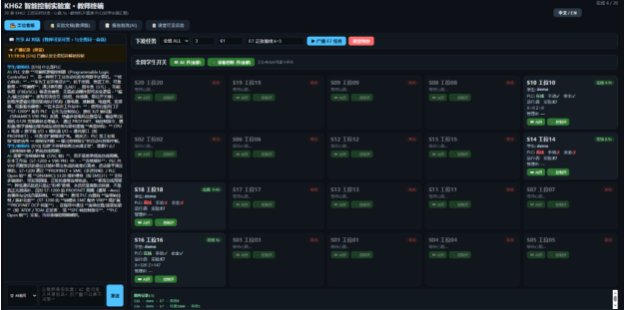
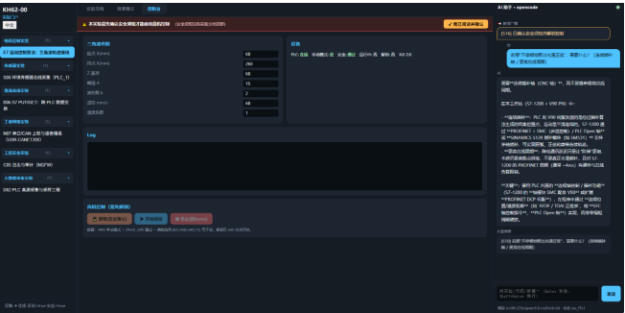
To support teaching and assessment, the system builds a tripartite platform integrating a student portal, a teacher control console, and an AI teaching assistant. On the student side, “learn–view–practice” can be completed on a single page; students can view practical project documents, real-machine trajectories, environmental curves, and cross-PLC data, and control the real machine. On the teacher side, a 20-workstation dashboard enables centralized classroom management, supporting task broadcasting, AI grading of reports, comment feedback, and permission management. Relying on the TIA Openness toolchain, the system can also achieve engineering interpretation, online comparison, factory package generation, and one-click recovery, making the PLC a readable, modifiable, and recoverable engineering object.
In terms of safety, the system provides layered protection including operation access control, a teacher master switch, download levels L0–L3, a master template and recovery SOP, and hardware red lines. Every student control action requires a real-time permission request to the teacher side. PLC programming courses open read-only, practice, authorized download, and end-of-course comprehensive modes by level. After class, the factory program can be restored with one click, safeguarding the bottom line of hardware safety while enabling frequent modifications and rapid restoration.
In the future, the system can be used for single-station teaching or expanded into a 20-workstation cluster uniformly managed by a laboratory network, suitable for large-scale teaching and skills competitions. The existing 59 practical projects can be smoothly expanded to modules such as industrial vision AI quality inspection, predictive maintenance, digital twins, edge computing, and cloud-edge collaboration. With reserved PROFINET, TCP, CAN, and Modbus interfaces, the system can connect collaborative robots, AGVs, machine vision, and 5G/TSN equipment, providing support for the upgrading of majors such as automation, mechatronics, industrial internet, industrial control security, and intelligent manufacturing.
The completion and commissioning of the KH62-00 system is another achievement of the university’s deep commitment to digital and intelligent teaching reform and its promotion of the deep integration of AI with discipline construction. The university will continue to advance teaching from "completion and implementation" to "regular use" and “deep application,” embed digital tools into all aspects of talent cultivation, cultivate high-quality applied talents suited to the comprehensive revitalization of Liaoning, and contribute Shen Gong wisdom to the high-quality development of higher education.
Translated by Basic Courses Department