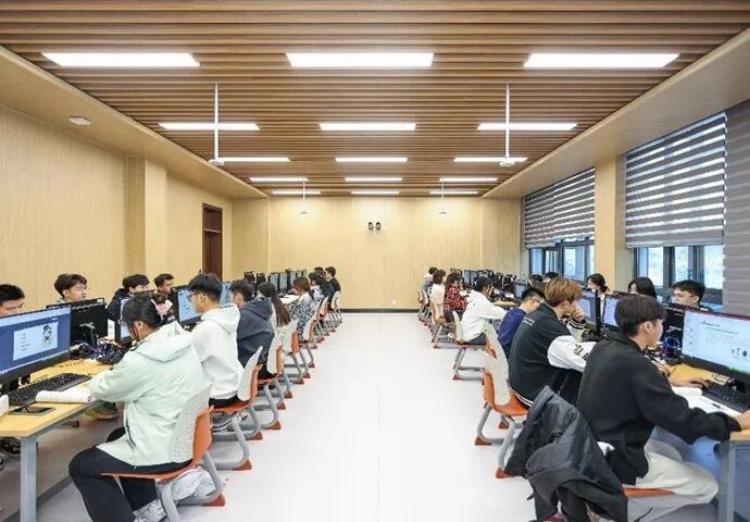
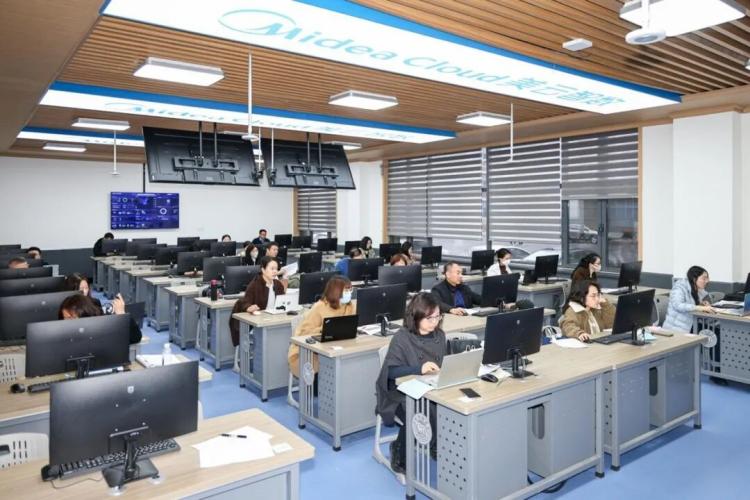
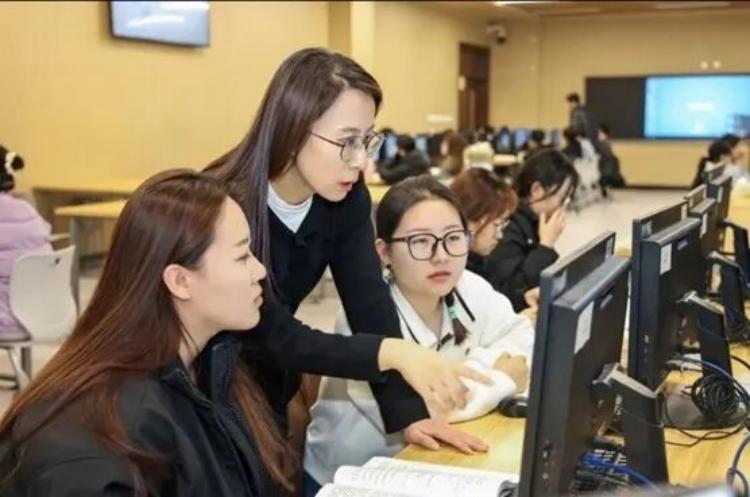
To fully advance the university’s digital transformation and consolidate the teaching foundation for high-quality talent development, the university has launched a comprehensive program of digital capacity building and training for teachers. With enthusiastic participation across the campus, faculty members have embraced this journey of professional upgrading, fostered a strong learning atmosphere and delivered impressive results.
The School of Information and Control Engineering took first place university-wide, with a pass rate of 85.52% at the elementary level and 32.41% at the intermediate level. The School of Economics and Management achieved an elementary pass rate of 71.43% and an intermediate pass rate of 33.04%, ranking first in the university for intermediate performance. Behind these outstanding achievements lie targeted measures, innovation, and dedicated efforts from all colleges. The School of Information and Control Engineering has refined an integrated training model of “teaching–research–projects–competitions”, breaking through traditional training barriers. Through university-enterprise collaboration, the school established project-based teaching workshops, enabling teachers to engage immersivity in the full chain of enterprise project practice. The school requires curriculum design to dynamically integrate cutting-edge industrial technologies and real cases, pushing faculty to keep pace with technological trends and strengthen engineering practice capabilities in a virtuous cycle of “teaching, learning, doing, and competing”.
The School of Economics and Management has built a three-dimensional learning mechanism: leadership demonstration, interdisciplinary coordination, and group mutual support, achieving full participation and coverage across all majors. Based on core disciplines and post requirements, each major formed specialized study groups for collective discussion, case analysis, and hands-on practice. Peer support within groups effectively solved problems such as weak individual motivation and lack of timely guidance.
The school collaborated with experts from leading enterprises to investigate job demands across 12 major business modules, developing a customized offline curriculum system of 564 class hours covering mainstream digital tools including Kingdee Cloud Galaxy and UFIDA Cloud9. Supported by the Midea Meijing Platform, 34 specialized laboratories were established, providing a full-chain system of theoretical learning, hands-on training, and scenario-based application. Centered on project delivery, the school used large-scale projects worth 2.4 million yuan, such as the Shenyang Institute of Technology–UFIDA Enterprise Digital Transformation and Innovation Service Center, to enhance teachers’ capabilities in real practice and form a positive cycle of “project practice – curriculum development – achievement output”.
“Digitization is not just a tool to support teaching, but a key engine reshaping the educational ecosystem,” said Zhang Zhuhua, Dean of the School of Information and Control Engineering. The core of the training is to make teachers a bridge between technology and education. What teachers gain is far more than a certificate; it is the solid ability to translate industrial reality and cutting-edge technology into high-quality teaching resources, so as to cultivate outstanding talents who meet future industrial needs and can solve complex engineering challenges. Zhang added that teachers are systematically studying Huawei’s core digital technologies, including Kunpeng, Ascend, 5G, data communications, AI, and big data. Driven by industry-education integration, instruction is shifting from knowledge transmission to developing interdisciplinary capabilities for solving complex industrial problems. Dynamic integration of cutting-edge technologies, real cases, and enterprise standards requires teachers to continuously update their skills, expand interdisciplinary vision, and strengthen engineering practice. The university’s training program has provided valuable access to advanced technical training and practice.
Wu Qiong, Dean of the School of Economics and Management, noted: “Digital transformation is not an option, but a compulsory course. Only when teachers possess strong digital capabilities can we cultivate interdisciplinary talents that meet industrial demands.” Wu set an example of lifelong learning by completing 7 digital courses and leading the whole faculty.
A number of outstanding faculty members have emerged during the digital training. Sun Nan, deputy head of the Accounting program in the School of Economics and Management, completed 9 training programs including Kingdee Cloud Galaxy, UFIDA Cloud9, and Inspur Enterprise Informationization, while integrating digital technologies into teaching to cultivate students’ systematic thinking. Teacher Feng Fan passed both elementary and intermediate training in Kingdee Cloud Galaxy and UFIDA Cloud9, plus 8 Huawei application skills certifications, demonstrating strong interdisciplinary digital competence.
Teachers’ performance has been widely praised. Zhou Min, Project Director of the Industry College at Midea IoT Technology Co., Ltd., highly commended: “Shenyang Institute of Technology has shown extraordinary execution in digital talent training. The teachers’ enthusiasm, cooperation, and ability to translate learning into practice are truly impressive.”
Students have also benefited greatly. Li Yingnan, a student majoring in Human Resource Management, said: “The digital skills we learn in class directly match enterprise job requirements, filling us with confidence for future employment.” The fruitful outcomes of digital teacher training demonstrate the university’s strong determination and solid progress in advancing educational digital transformation.
In the future, the university will continue to deepen the strategy of “research-led, project-driven, competition-honed” development, turning teachers’ strong digital capabilities into high-quality resources for talent cultivation, and nurturing more outstanding interdisciplinary talents for future industrial development.
Translated by Basic Courses Department