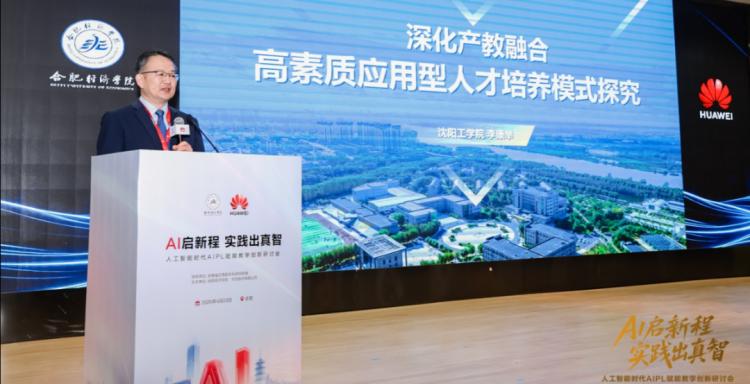
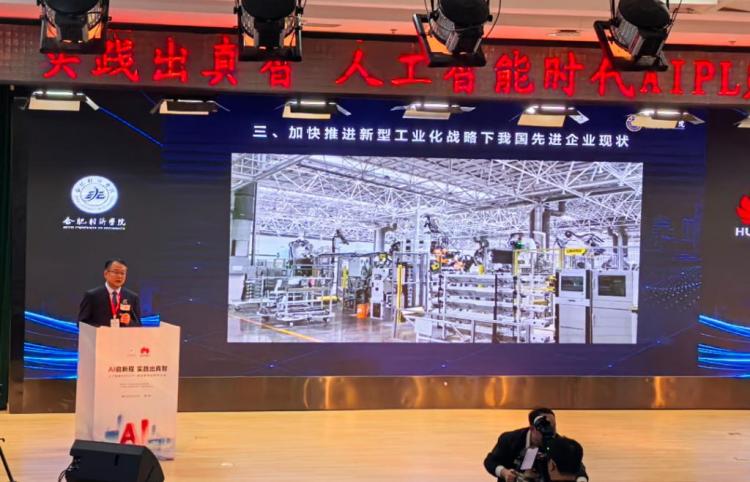
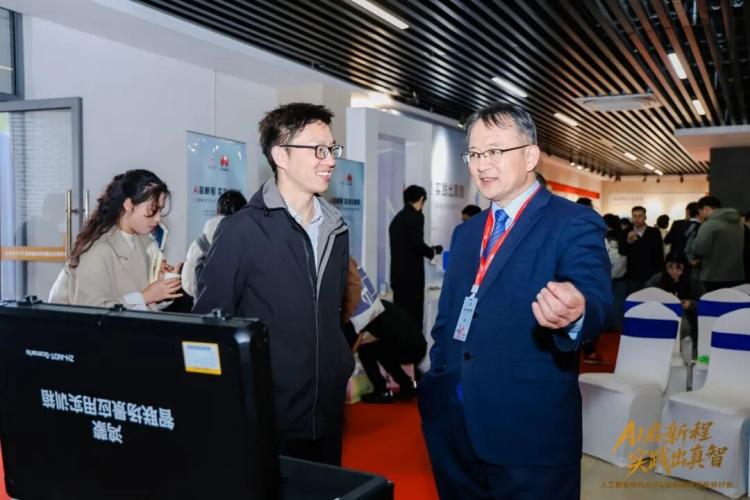
On April 23, Hefei University of Economics and Technology, in collaboration with Huawei Technologies Co., Ltd., jointly held the seminar titled "Embarking on a New Journey with AI, True Wisdom from Practice — AIPL Empowering Teaching Innovation in the Age of Artificial Intelligence," along with the unveiling ceremony of the Hefei University of Economics and Technology AI Practice Lab. The event stood at the forefront of industry-education integration, exploring the practical implementation of "discipline + AI technology" in education and teaching, and building a platform for experience sharing, intellectual exchange, and resource connectivity to support the high-quality development of higher education in the new era. Li Kangju, President of our institute, was invited to attend the event and delivered a keynote report titled "Deepening Industry-Education Integration: Exploring the Cultivation Model of High-Quality Applied Talents," in which he systematically shared the institute's development strategies in the digital and intelligent era, educational achievements, innovative practices in the construction of modern industrial colleges, and the high-quality employment of its graduates, attracting widespread attention.
In his report, Li Kangju elaborated in depth on three core areas: the impact of current changes on higher education institutions, the effectiveness of building modern industrial colleges, and the outcomes of talent cultivation. He pointed out that the global transformation driven by digital and intelligent technologies is reshaping the industrial landscape. The rapid development of cutting-edge technologies such as 5G, artificial intelligence, and the Internet of Things has presented entirely new challenges for university talent cultivation. Cultivating high-quality, versatile talents who can adapt to the digital and intelligent age has become a common task for the global education community, and private colleges, in particular, must proactively seek change and accelerate their digital transformation.
Li Kangju provided a detailed account of our institute’s practical exploration of deepening industry-education integration in collaboration with Huawei in the digital and intelligent era. He highlighted the “Shenyang Institute of Technology model” centered on the construction of modern industrial colleges, and discussed innovative pathways for cultivating new types of talent driven by AI technology with all participants. Closely aligned with industrial needs and actively responding to the national call for the construction of emerging engineering disciplines, the institute has built a school-enterprise collaborative ecosystem focused on the field of intelligent manufacturing. By integrating the strengths of both the university and enterprises, the institute has established deep partnerships with leading domestic and international companies such as Huawei, Midea, Rockwell Automation, Huazhong CNC, KUKA, and Inspur. To date, it has set up 21 modern industrial colleges, including the Huawei-Shenyang Institute of Technology Modern Industrial College, the Shenyang Institute of Technology-Midea Digital Lighthouse College, the Inspur Industrial Internet College Joint Innovation Center, and the KUKA Authorized Industrial Robotics College. Together, these platforms form a teaching system that covers the entire production process of modern manufacturing, cultivating high-quality applied talents who are not only familiar with the architecture and processes of modern manufacturing but also proficient in cutting-edge production technologies and skilled in using digital tools, thereby providing solid human resources support for industrial transformation and upgrading.
In concrete practice, relying on its industrial colleges, our institute has innovatively developed a school-enterprise collaborative education model characterized by "six forms of cooperation and five types of integration." The institute and enterprises jointly formulate talent cultivation plans, develop specialized courses, actively expand cooperation within enterprise ecosystems, deepen industry-education integration and the transformation of achievements, tap into diverse internship and employment resources, and enhance internationalization by collaborating with universities in countries along the Belt and Road to cultivate internationally oriented applied talents with expertise in both their discipline and foreign languages. The "order-based" and "customized" training models precisely align with corporate needs, resulting in high demand for students in these programs and enabling graduates to achieve high-quality employment.
Being invited to attend this seminar not only demonstrates our institute's exploratory achievements and leading advantages in the field of talent cultivation through industry-education integration in the digital and intelligent era, but also provides practical experience that can serve as a reference for the high-quality development of private universities nationwide.
Translated by Basic Courses Department